|
The
great chain of being sure about things - 31st October
2015
The
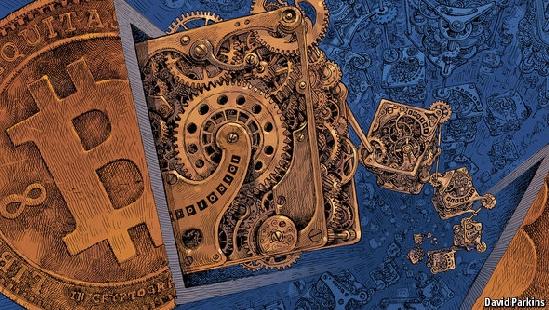
technology behind bitcoin lets people who do not know
or trust each other build a dependable ledger. This
has implications far beyond the cryptocurrency


Your
text advertisement here from as little as $100USD
per 12 months

Profiles
Television
Music
Movies
Hollywood
WWE
Wrestling
Business
Gaming
Entertainment
Advertising
Promotions
WHEN
the Honduran police came to evict her in 2009 Mariana
Catalina Izaguirre had lived in her lowly house for
three decades. Unlike many of her neighbours in Tegucigalpa,
the country’s capital, she even had an official
title to the land on which it stood. But the records
at the country’s Property Institute showed another
person registered as its owner, too—and that
person convinced a judge to sign an eviction order.
By the time the legal confusion was finally sorted
out, Ms Izaguirre’s house had been demolished.
It
is the sort of thing that happens every day in places
where land registries are badly kept, mismanaged and/or
corrupt—which is to say across much of the world.
This lack of secure property rights is an endemic
source of insecurity and injustice. It also makes
it harder to use a house or a piece of land as collateral,
stymying investment and job creation.
Such
problems seem worlds away from bitcoin, a currency
based on clever cryptography which has a devoted following
among mostly well-off, often anti-government and sometimes
criminal geeks. But the cryptographic technology that
underlies bitcoin, called the “blockchain”,
has applications well beyond cash and currency. It
offers a way for people who do not know or trust each
other to create a record of who owns what that will
compel the assent of everyone concerned. It is a way
of making and preserving truths.
That
is why politicians seeking to clean up the Property
Institute in Honduras have asked Factom, an American
startup, to provide a prototype of a blockchain-based
land registry. Interest in the idea has also been
expressed in Greece, which has no proper land registry
and where only 7% of the territory is adequately mapped.
A
place in the past
Other
applications for blockchain and similar “distributed
ledgers” range from thwarting diamond thieves
to streamlining stockmarkets: the NASDAQ exchange
will soon start using a blockchain-based system to
record trades in privately held companies. The Bank
of England, not known for technological flights of
fancy, seems electrified: distributed ledgers, it
concluded in a research note late last year, are a
“significant innovation” that could have
“far-reaching implications” in the financial
industry.
The
politically minded see the blockchain reaching further
than that. When co-operatives and left-wingers gathered
for this year’s OuiShare Fest in Paris to discuss
ways that grass-roots organisations could undermine
giant repositories of data like Facebook, the blockchain
made it into almost every speech. Libertarians dream
of a world where more and more state regulations are
replaced with private contracts between individuals—contracts
which blockchain-based programming would make self-enforcing.
The
blockchain began life in the mind of Satoshi Nakamoto,
the brilliant, pseudonymous and so far unidentified
creator of bitcoin—a “purely peer-to-peer
version of electronic cash”, as he put it in
a paper published in 2008. To work as cash, bitcoin
had to be able to change hands without being diverted
into the wrong account and to be incapable of being
spent twice by the same person. To fulfil Mr Nakamoto’s
dream of a decentralised system the avoidance of such
abuses had to be achieved without recourse to any
trusted third party, such as the banks which stand
behind conventional payment systems.
It
is the blockchain that replaces this trusted third
party. A database that contains the payment history
of every bitcoin in circulation, the blockchain provides
proof of who owns what at any given juncture. This
distributed ledger is replicated on thousands of computers—bitcoin’s
“nodes”—around the world and is publicly
available. But for all its openness it is also trustworthy
and secure. This is guaranteed by the mixture of mathematical
subtlety and computational brute force built into
its “consensus mechanism”—the process
by which the nodes agree on how to update the blockchain
in the light of bitcoin transfers from one person
to another.
Let
us say that Alice wants to pay Bob for services rendered.
Both have bitcoin “wallets”—software
which accesses the blockchain rather as a browser
accesses the web, but does not identify the user to
the system. The transaction starts with Alice’s
wallet proposing that the blockchain be changed so
as to show Alice’s wallet a little emptier and
Bob’s a little fuller.
The
network goes through a number of steps to confirm
this change. As the proposal propagates over the network
the various nodes check, by inspecting the ledger,
whether Alice actually has the bitcoin she now wants
to spend. If everything looks kosher, specialised
nodes called miners will bundle Alice’s proposal
with other similarly reputable transactions to create
a new block for the blockchain.
This
entails repeatedly feeding the data through a cryptographic
“hash” function which boils the block down
into a string of digits of a given length (see diagram).
Like a lot of cryptography, this hashing is a one-way
street. It is easy to go from the data to their hash;
impossible to go from the hash back to the data. But
though the hash does not contain the data, it is still
unique to them. Change what goes into the block in
any way—alter a transaction by a single digit—and
the hash would be different.
Running
in the shadows
That
hash is put, along with some other data, into the
header of the proposed block. This header then becomes
the basis for an exacting mathematical puzzle which
involves using the hash function yet again. This puzzle
can only be solved by trial and error. Across the
network, miners grind through trillions and trillions
of possibilities looking for the answer. When a miner
finally comes up with a solution other nodes quickly
check it (that’s the one-way street again: solving
is hard but checking is easy), and each node that
confirms the solution updates the blockchain accordingly.
The hash of the header becomes the new block’s
identifying string, and that block is now part of
the ledger. Alice’s payment to Bob, and all the
other transactions the block contains, are confirmed.
This
puzzle stage introduces three things that add hugely
to bitcoin’s security. One is chance. You cannot
predict which miner will solve a puzzle, and so you
cannot predict who will get to update the blockchain
at any given time, except in so far as it has to be
one of the hard working miners, not some random interloper.
This makes cheating hard.
The
second addition is history. Each new header contains
a hash of the previous block’s header, which
in turn contains a hash of the header before that,
and so on and so on all the way back to the beginning.
It is this concatenation that makes the blocks into
a chain. Starting from all the data in the ledger
it is trivial to reproduce the header for the latest
block. Make a change anywhere, though—even back
in one of the earliest blocks—and that changed
block’s header will come out different. This
means that so will the next block’s, and all
the subsequent ones. The ledger will no longer match
the latest block’s identifier, and will be rejected.
Is
there a way round this? Imagine that Alice changes
her mind about paying Bob and tries to rewrite history
so that her bitcoin stays in her wallet. If she were
a competent miner she could solve the requisite puzzle
and produce a new version of the blockchain. But in
the time it took her to do so, the rest of the network
would have lengthened the original blockchain. And
nodes always work on the longest version of the blockchain
there is. This rule stops the occasions when two miners
find the solution almost simultaneously from causing
anything more than a temporary fork in the chain.
It also stops cheating. To force the system to accept
her new version Alice would need to lengthen it faster
than the rest of the system was lengthening the original.
Short of controlling more than half the computers—known
in the jargon as a “51% attack”—that
should not be possible.
Dreams
are sometimes catching
Leaving
aside the difficulties of trying to subvert the network,
there is a deeper question: why bother to be part
of it at all? Because the third thing the puzzle-solving
step adds is an incentive. Forging a new block creates
new bitcoin. The winning miner earns 25 bitcoin, worth
about $7,500 at current prices.
All
this cleverness does not, in itself, make bitcoin
a particularly attractive currency. Its value is unstable
and unpredictable (see chart), and the total amount
in circulation is deliberately limited. But the blockchain
mechanism works very well. According to blockchain.info,
a website that tracks such things, on an average day
more than 120,000 transactions are added to the blockchain,
representing about $75m exchanged. There are now 380,000
blocks; the ledger weighs in at nearly 45 gigabytes.
Most
of the data in the blockchain are about bitcoin. But
they do not have to be. Mr Nakamoto has built what
geeks call an “open platform”—a distributed
system the workings of which are open to examination
and elaboration. The paragon of such platforms is
the internet itself; other examples include operating
systems like Android or Windows. Applications that
depend on basic features of the blockchain can thus
be developed without asking anybody for permission
or paying anyone for the privilege. “The internet
finally has a public data base,” says Chris Dixon
of Andreessen Horowitz, a venture-capital firm which
has financed several bitcoin start-ups, including
Coinbase, which provides wallets, and 21, which makes
bitcoin-mining hardware for the masses.
For
now blockchain-based offerings fall in three buckets.
The first takes advantage of the fact that any type
of asset can be transferred using the blockchain.
One of the startups betting on this idea is Colu.
It has developed a mechanism to “dye” very
small bitcoin transactions (called “bitcoin dust”)
by adding extra data to them so that they can represent
bonds, shares or units of precious metals.
Protecting
land titles is an example of the second bucket: applications
that use the blockchain as a truth machine. Bitcoin
transactions can be combined with snippets of additional
information which then also become embedded in the
ledger. It can thus be a registry of anything worth
tracking closely. Everledger uses the blockchain to
protect luxury goods; for example it will stick on
to the blockchain data about a stone’s distinguishing
attributes, providing unchallengeable proof of its
identity should it be stolen. Onename stores personal
information in a way that is meant to do away with
the need for passwords; CoinSpark acts as a notary.
Note, though, that for these applications, unlike
for pure bitcoin transactions, a certain amount of
trust is required; you have to believe the intermediary
will store the data accurately.
It
is the third bucket that contains the most ambitious
applications: “smart contracts” that execute
themselves automatically under the right circumstances.
Bitcoin can be “programmed” so that it only
becomes available under certain conditions. One use
of this ability is to defer the payment miners get
for solving a puzzle until 99 more blocks have been
added—which provides another incentive to keep
the blockchain in good shape.
Lighthouse,
a project started by Mike Hearn, one of bitcoin’s
leading programmers, is a decentralised crowdfunding
service that uses these principles. If enough money
is pledged to a project it all goes through; if the
target is never reached, none does. Mr Hearn says
his scheme will both be cheaper than non-bitcoin competitors
and also more independent, as governments will be
unable to pull the plug on a project they don’t
like.
Energy
is contagious
The
advent of distributed ledgers opens up an “entirely
new quadrant of possibilities”, in the words
of Albert Wenger of USV, a New York venture firm that
has invested in startups such as OpenBazaar, a middleman-free
peer-to-peer marketplace. But for all that the blockchain
is open and exciting, sceptics argue that its security
may yet be fallible and its procedures may not scale.
What works for bitcoin and a few niche applications
may be unable to support thousands of different services
with millions of users.
Though
Mr Nakamoto’s subtle design has so far proved
impregnable, academic researchers have identified
tactics that might allow a sneaky and well financed
miner to compromise the block chain without direct
control of 51% of it. And getting control of an appreciable
fraction of the network’s resources looks less
unlikely than it used to. Once the purview of hobbyists,
bitcoin mining is now dominated by large “pools”,
in which small miners share their efforts and rewards,
and the operators of big data centres, many based
in areas of China, such as Inner Mongolia, where electricity
is cheap.
Another
worry is the impact on the environment. With no other
way to establish the bona fides of miners, the bitcoin
architecture forces them to do a lot of hard computing;
this “proof of work”, without which there
can be no reward, insures that all concerned have
skin in the game. But it adds up to a lot of otherwise
pointless computing. According to blockchain.info
the network’s miners are now trying 450 thousand
trillion solutions per second. And every calculation
takes energy.
Because
miners keep details of their hardware secret, nobody
really knows how much power the network consumes.
If everyone were using the most efficient hardware,
its annual electricity usage might be about two terawatt-hours—a
bit more than the amount used by the 150,000 inhabitants
of King’s County in California’s Central
Valley. Make really pessimistic assumptions about
the miners’ efficiency, though, and you can get
the figure up to 40 terawatt-hours, almost two-thirds
of what the 10m people in Los Angeles County get through.
That surely overstates the problem; still, the more
widely people use bitcoin, the worse the waste could
get.
Yet
for all this profligacy bitcoin remains limited. Because
Mr Nakamoto decided to cap the size of a block at
one megabyte, or about 1,400 transactions, it can
handle only around seven transactions per second,
compared to the 1,736 a second Visa handles in America.
Blocks could be made bigger; but bigger blocks would
take longer to propagate through the network, worsening
the risks of forking.
Earlier
platforms have surmounted similar problems. When millions
went online after the invention of the web browser
in the 1990s pundits predicted the internet would
grind to a standstill: eppur si muove. Similarly,
the bitcoin system is not standing still. Specialised
mining computers can be very energy efficient, and
less energy-hungry alternatives to the proof-of-work
mechanism have been proposed. Developers are also
working on an add-on called “Lightning”
which would handle large numbers of smaller transactions
outside the blockchain. Faster connections will let
bigger blocks propagate as quickly as small ones used
to.
The
problem is not so much a lack of fixes. It is that
the network’s “bitcoin improvement process”
makes it hard to choose one. Change requires community-wide
agreement, and these are not people to whom consensus
comes easily. Consider the civil war being waged over
the size of blocks. One camp frets that quickly increasing
the block size will lead to further concentration
in the mining industry and turn bitcoin into more
of a conventional payment processor. The other side
argues that the system could crash as early as next
year if nothing is done, with transactions taking
hours.
A
break in the battle
Mr
Hearn and Gavin Andresen, another bitcoin grandee,
are leaders of the big-block camp. They have called
on mining firms to install a new version of bitcoin
which supports a much bigger block size. Some miners
who do, though, appear to be suffering cyber-attacks.
And in what seems a concerted effort to show the need
for, or the dangers of, such an upgrade, the system
is being driven to its limits by vast numbers of tiny
transactions.
This
has all given new momentum to efforts to build an
alternative to the bitcoin blockchain, one that might
be optimised for the storing of distributed ledgers
rather than for the running of a cryptocurrency. MultiChain,
a build-your-own-blockchain platform offered by Coin
Sciences, another startup, demonstrates what is possible.
As well as offering the wherewithal to build a public
blockchain like bitcoin’s, it can also be used
to build private chains open only to vetted users.
If all the users start off trusted the need for mining
and proof-of-work is reduced or eliminated, and a
currency attached to the ledger becomes an optional
extra.
The
first industry to adopt such sons of blockchain may
well be the one whose failings originally inspired
Mr Nakamoto: finance. In recent months there has been
a rush of bankerly enthusiasm for private blockchains
as a way of keeping tamper-proof ledgers. One of the
reasons, irony of ironies, is that this technology
born of anti-government libertarianism could make
it easier for the banks to comply with regulatory
requirements on knowing their customers and anti-money-laundering
rules. But there is a deeper appeal.
Industrial
historians point out that new powers often become
available long before the processes that best use
them are developed. When electric motors were first
developed they were deployed like the big hulking
steam engines that came before them. It took decades
for manufacturers to see that lots of decentralised
electric motors could reorganise every aspect of the
way they made things. In its report on digital currencies,
the Bank of England sees something similar afoot in
the financial sector. Thanks to cheap computing financial
firms have digitised their inner workings; but they
have not yet changed their organisations to match.
Payment systems are mostly still centralised: transfers
are cleared through the central bank. When financial
firms do business with each other, the hard work of
synchronising their internal ledgers can take several
days, which ties up capital and increases risk.
Distributed
ledgers that settle transactions in minutes or seconds
could go a long way to solving such problems and fulfilling
the greater promise of digitised banking. They could
also save banks a lot of money: according to Santander,
a bank, by 2022 such ledgers could cut the industry’s
bills by up to $20 billion a year. Vendors still need
to prove that they could deal with the far-higher-than-bitcoin
transaction rates that would be involved; but big
banks are already pushing for standards to shape the
emerging technology. One of them, UBS, has proposed
the creation of a standard “settlement coin”.
The first order of business for R3 CEV, a blockchain
startup in which UBS has invested alongside Goldman
Sachs, JPMorgan and 22 other banks, is to develop
a standardised architecture for private ledgers.
The
banks’ problems are not unique. All sorts of
companies and public bodies suffer from hard-to-maintain
and often incompatible databases and the high transaction
costs of getting them to talk to each other. This
is the problem Ethereum, arguably the most ambitious
distributed-ledger project, wants to solve. The brainchild
of Vitalik Buterin, a 21-year-old Canadian programming
prodigy, Ethereum’s distributed ledger can deal
with more data than bitcoin’s can. And it comes
with a programming language that allows users to write
more sophisticated smart contracts, thus creating
invoices that pay themselves when a shipment arrives
or share certificates which automatically send their
owners dividends if profits reach a certain level.
Such cleverness, Mr Buterin hopes, will allow the
formation of “decentralised autonomous organisations”—virtual
companies that are basically just sets of rules running
on Ethereum’s blockchain.
One
of the areas where such ideas could have radical effects
is in the “internet of things”—a network
of billions of previously mute everyday objects such
as fridges, doorstops and lawn sprinklers. A recent
report from IBM entitled “Device Democracy”
argues that it would be impossible to keep track of
and manage these billions of devices centrally, and
unwise to to try; such attempts would make them vulnerable
to hacking attacks and government surveillance. Distributed
registers seem a good alternative.
The
sort of programmability Ethereum offers does not just
allow people’s property to be tracked and registered.
It allows it to be used in new sorts of ways. Thus
a car-key embedded in the Ethereum blockchain could
be sold or rented out in all manner of rule-based
ways, enabling new peer-to-peer schemes for renting
or sharing cars. Further out, some talk of using the
technology to make by-then-self-driving cars self-owning,
to boot. Such vehicles could stash away some of the
digital money they make from renting out their keys
to pay for fuel, repairs and parking spaces, all according
to preprogrammed rules.
What
would Rousseau have said?
Unsurprisingly,
some think such schemes overly ambitious. Ethereum’s
first (“genesis”) block was only mined in
August and, though there is a little ecosystem of
start-ups clustered around it, Mr Buterin admitted
in a recent blog post that it is somewhat short of
cash. But the details of which particular blockchains
end up flourishing matter much less than the broad
enthusiasm for distributed ledgers that is leading
both start-ups and giant incumbents to examine their
potential. Despite society’s inexhaustible ability
to laugh at accountants, the workings of ledgers really
do matter.
Today’s
world is deeply dependent on double-entry book-keeping.
Its standardised system of recording debits and credits
is central to any attempt to understand a company’s
financial position. Whether modern capitalism absolutely
required such book-keeping in order to develop, as
Werner Sombart, a German sociologist, claimed in the
early 20th century, is open to question. Though the
system began among the merchants of renaissance Italy,
which offers an interesting coincidence of timing,
it spread round the world much more slowly than capitalism
did, becoming widely used only in the late 19th century.
But there is no question that the technique is of
fundamental importance not just as a record of what
a company does, but as a way of defining what one
can be.
Ledgers
that no longer need to be maintained by a company—or
a government—may in time spur new changes in
how companies and governments work, in what is expected
of them and in what can be done without them. A realisation
that systems without centralised record-keeping can
be just as trustworthy as those that have them may
bring radical change.
Such
ideas can expect some eye-rolling—blockchains
are still a novelty applicable only in a few niches,
and the doubts as to how far they can spread and scale
up may prove well founded. They can also expect resistance.
Some of bitcoin’s critics have always seen it
as the latest techy attempt to spread a “Californian
ideology” which promises salvation through technology-induced
decentralisation while ignoring and obfuscating the
realities of power—and happily concentrating
vast wealth in the hands of an elite. The idea of
making trust a matter of coding, rather than of democratic
politics, legitimacy and accountability, is not necessarily
an appealing or empowering one.
At
the same time, a world with record-keeping mathematically
immune to manipulation would have many benefits. Evicted
Ms Izaguirre would be better off; so would many others
in many other settings. If blockchains have a fundamental
paradox, it is this: by offering a way of setting
the past and present in cryptographic stone, they
could make the future a very different place.
(The
Economist)
|