|
Alphabet:
News
Websites
Alphabet
Alphabet:
Investor Relations
Google

SEJ
· SEO
Google’s
Recommender System Breakthrough Detects Semantic Intent
Google
quietly published a research paper on personalized
semantics for recommender systems like Google Discover
and YouTube.
January
6, 2026
(In
Case You Missed It)
By
Roger Montti
Google
published a research paper about helping recommender
systems understand what users mean when they interact
with them. Their goal with this new approach is to
overcome the limitations inherent in the current state-of-the-art
recommender systems in order to get a finer, detailed
understanding of what users want to read, listen to,
or watch at the level of the individual.
Personalized
Semantics
Recommender
systems predict what a user would like to read or
watch next. YouTube, Google Discover, and Google News
are examples of recommender systems for recommending
content to users. Other kinds of recommender systems
are shopping recommendations.
Recommender
systems generally work by collecting data about the
kinds of things a user clicks on, rates, buys, and
watches and then using that data to suggest more content
that aligns with a user’s preferences.
The
researchers referred to those kinds of signals as
primitive user feedback because they’re not so
good at recommendations based on an individual’s
subjective judgment about what’s funny, cute,
or boring.
The
intuition behind the research is that the rise of
LLMs presents an opportunity to leverage natural language
interactions to better understand what a user wants
through identifying semantic intent.
The
researchers explain:
“Interactive
recommender systems have emerged as a promising paradigm
to overcome the limitations of the primitive user
feedback used by traditional recommender systems (e.g.,
clicks, item consumption, ratings). They allow users
to express intent, preferences, constraints, and contexts
in a richer fashion, often using natural language
(including faceted search and dialogue). (Search Engine
Journal)
Full
article via Search Engine Journal
@sejournal
https://searchenginejournal.com/googles-recommender-system-breakthrough-detects-semantic-intent/564393/
Social
Media
Media
Man Peg On
SEJ's
Roger on Google and YouTube recommendation synaptics
aka systems. Our pop culture reference on today's
Search Engine Journal web tips is that if it's a "recommendation"
from the powers that be at Google/YouTube/Alphabet
you might want to think closely about doing it, akin
to the original families in New York. They are calling
it a "recommendation". Just having a bit
of fun with this one boss. Back to the webcode and
algorithms boss. Special project perhaps for the new
recruits from Tony's establishment. Not much escapes
"The Big G". Media chapter logging out until
the late shift at The Plex.
Profiles
Social
Media Business
Search
Engines

Multimedia
Alphabet
2023 Q4 Earnings Call

Search
Engine News
May
20, 2024
Alphabet's
Google has preemptively paid damages to the U.S. government,
an unusual move aimed at avoiding a jury trial in
the Justice Department's antitrust lawsuit over its
digital advertising business.
Google
disclosed, opens new tab the payment, but not the
amount, in a court filing last week that said the
case should be heard and decided by a judge directly.
Without a monetary damages claim, Google argued, the
government has no right to a jury trial.
The
Justice Department, which has not said if it will
accept the payment, declined to comment on the filing.
Google
asserted that its check, which it said covered its
alleged overcharges for online ads, allows it to sidestep
a jury trial whether or not the government takes it.
The
Justice Department filed the case last year with Virginia
and other states, alleging Google was stifling competition
for advertising technology. The government has said
Google should be forced to sell its ad manager suite.
Google,
which has denied the allegations, said in a statement
that the Justice Department “manufactured a damages
claim at the last minute in an attempt to secure a
jury trial.” Without disclosing the size of its
payment, Google said that after months of discovery,
the Justice Department could only point to estimated
damages of less than $1 million.
The
company said the government has said the case is “highly
technical” and “outside the everyday knowledge
of most prospective jurors.”
The
Justice Department will have a chance to respond to
Google's arguments before a judge considers the question
at a hearing scheduled for June 21 in Alexandria,
Virginia, federal court. The trial is set for September,
currently before a jury.
Stanford
Law School's Mark Lemley told media he was skeptical
Google’s gambit would prevail. He said a jury
could ultimately decide higher damages than whatever
Google put forward.
“Antitrust
cases regularly go to juries. I think it is a sign
that Google is worried about what a jury will do,”
Lemley said.
Another
legal scholar, Herbert Hovenkamp of the University
of Pennsylvania’s law school, called Google's
move "smart" in a post on X. “Juries
are bad at deciding technical cases, and further they
do not have the authority to order a breakup,”
he wrote.
The
U.S. Supreme Court ruled in a 2016 case that an offer
for “complete relief” did not wipe out a
class-action claim. But Google argued its payment
is different, because it submitted an actual check
and not merely an offer.
Google
has faced two antitrust trials in recent months, but
only one involved a jury.
In
that case, a jury in San Francisco ruled for “Fortnite”
maker Epic Games that Google illegally barred competing
Android app stores and forced developers to use its
payment system for in-app transactions.
In
the other case, a Washington, D.C. federal judge is
weighing allegations that Google has unlawfully stifled
competition for web search. The court heard closing
arguments this month but has not ruled.
The
case is United States v. Google LLC, U.S. District
Court for the Eastern District of Virginia, No. 1:23-cv-00108.
For
U.S.: Julia Tarver Wood and Aaron Teitelbaum of the
Department of Justice
For
Google: Eric Mahr and Andrew Ewalt of Freshfields
Bruckhaus Deringer; Kannon Shanmugam and Karen Dunn
of Paul, Weiss, Rifkind, Wharton & Garrison; and
Daniel Bitton and Bradley Justus of Axinn, Veltrop
& Harkrider.
(Wires)
G
is for Google
As
part of that, we also said that you could expect us
to make “smaller bets in areas that might seem
very speculative or even strange when compared to
our current businesses.” From the start, we’ve
always strived to do more, and to do important and
meaningful things with the resources we have.
We
did a lot of things that seemed crazy at the time.
Many of those crazy things now have over a billion
users, like Google Maps, YouTube, Chrome, and Android.
And we haven’t stopped there. We are still trying
to do things other people think are crazy but we are
super excited about.
We’ve
long believed that over time companies tend to get
comfortable doing the same thing, just making incremental
changes. But in the technology industry, where revolutionary
ideas drive the next big growth areas, you need to
be a bit uncomfortable to stay relevant.
Our
company is operating well today, but we think we can
make it cleaner and more accountable. So we are creating
a new company, called Alphabet. I am really excited
to be running Alphabet as CEO with help from my capable
partner, Sergey, as President.
What
is Alphabet? Alphabet is mostly a collection of companies.
The largest of which, of course, is Google. This newer
Google is a bit slimmed down, with the companies that
are pretty far afield of our main internet products
contained in Alphabet instead. What do we mean by
far afield? Good examples are our health efforts:
Life Sciences (that works on the glucose-sensing contact
lens), and Calico (focused on longevity). Fundamentally,
we believe this allows us more management scale, as
we can run things independently that aren’t very
related.
Alphabet
is about businesses prospering through strong leaders
and independence. In general, our model is to have
a strong CEO who runs each business, with Sergey and
me in service to them as needed. We will rigorously
handle capital allocation and work to make sure each
business is executing well. We’ll also make sure
we have a great CEO for each business, and we’ll
determine their compensation. In addition, with this
new structure we plan to implement segment reporting
for our Q4 results, where Google financials will be
provided separately than those for the rest of Alphabet
businesses as a whole.
This
new structure will allow us to keep tremendous focus
on the extraordinary opportunities we have inside
of Google. A key part of this is Sundar Pichai. Sundar
has been saying the things I would have said (and
sometimes better!) for quite some time now, and I’ve
been tremendously enjoying our work together. He has
really stepped up since October of last year, when
he took on product and engineering responsibility
for our internet businesses. Sergey and I have been
super excited about his progress and dedication to
the company. And it is clear to us and our board that
it is time for Sundar to be CEO of Google. I feel
very fortunate to have someone as talented as he is
to run the slightly slimmed down Google and this frees
up time for me to continue to scale our aspirations.
I have been spending quite a bit of time with Sundar,
helping him and the company in any way I can, and
I will of course continue to do that. Google itself
is also making all sorts of new products, and I know
Sundar will always be focused on innovation—continuing
to stretch boundaries. I know he deeply cares that
we can continue to make big strides on our core mission
to organize the world’s information. Recent launches
like Google Photos and Google Now using machine learning
are amazing progress. Google also has some services
that are run with their own identity, like YouTube.
Susan is doing a great job as CEO, running a strong
brand and driving incredible growth.
Sergey
and I are seriously in the business of starting new
things. Alphabet will also include our X lab, which
incubates new efforts like Wing, our drone delivery
effort. We are also stoked about growing our investment
arms, Ventures and Capital, as part of this new structure.
Alphabet
Inc. will replace Google Inc. as the publicly-traded
entity and all shares of Google will automatically
convert into the same number of shares of Alphabet,
with all of the same rights. Google will become a
wholly-owned subsidiary of Alphabet. Our two classes
of shares will continue to trade on Nasdaq as GOOGL
and GOOG.
For
Sergey and me this is a very exciting new chapter
in the life of Google—the birth of Alphabet.
We liked the name Alphabet because it means a collection
of letters that represent language, one of humanity’s
most important innovations, and is the core of how
we index with Google search! We also like that it
means alpha-bet (Alpha is investment return above
benchmark), which we strive for! I should add that
we are not intending for this to be a big consumer
brand with related products—the whole point is
that Alphabet companies should have independence and
develop their own brands.
We
are excited about…
Getting
more ambitious things done.
Taking the long-term view.
Empowering great entrepreneurs and companies to flourish.
Investing at the scale of the opportunities and resources
we see.
Improving the transparency and oversight of what we’re
doing.
Making Google even better through greater focus.
Larry
Page
Alphabet
Inc. is an American multinational technology conglomerate
holding company headquartered in Mountain View, California.
It was created through a restructuring of Google on
October 2, 2015,] and became the parent company of
Google and several former Google subsidiaries. Alphabet
is the world's third-largest technology company by
revenue and one of the world's most valuable companies.]
It is one of the Big Five American information technology
companies, alongside Amazon, Apple, Meta and Microsoft.
The
establishment of Alphabet Inc. was prompted by a desire
to make the core Google business "cleaner and
more accountable" while allowing greater autonomy
to group companies that operate in businesses other
than Internet services. Founders Larry Page and Sergey
Brin announced their resignation from their executive
posts in December 2019, with the CEO role to be filled
by Sundar Pichai, also the CEO of Google. Page and
Brin remain employees, board members, and controlling
shareholders of Alphabet Inc.
(Wikipedia)
Media
Man
FAANG
Directory
Facebook
Amazon Apple
Netflix Google
Profiles
Social
Media Business
Search
Engines
Websites
Facebook
Amazon
Apple
Netflix
Google
In
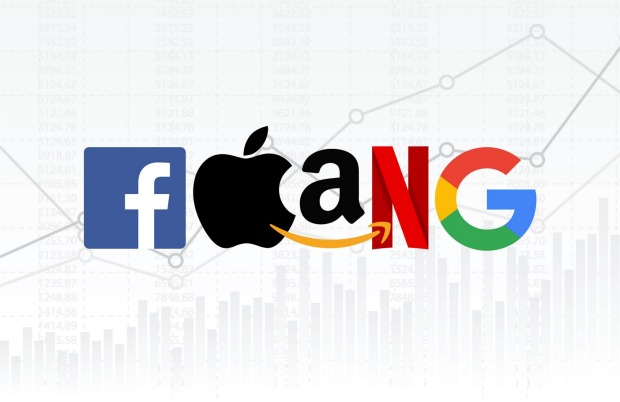
finance, “FAANG” is an acronym that refers
to the stocks of five prominent American technology
companies: Meta (META) (formerly known as Facebook),
Amazon (AMZN), Apple (AAPL), Netflix (NFLX); and Alphabet
(GOOG) (formerly known as Google).
The
term was popularized by Jim Cramer, the television
host of CNBC's Mad Money, in 2013, who praised these
companies for being “totally dominant in their
markets." Originally, the term "FANG"
was used, with Apple—the second “A”
in the acronym—added in 2017.
FAANG
is an acronym referring to the stocks of the five
most popular and best-performing American technology
companies.
These
are: Meta (formerly known as Facebook); Amazon; Apple;
Netflix; and Alphabet (formerly known as Google).
In
addition to being widely known among consumers, the
five FAANG stocks are among the largest companies
in the world.
Some
have raised concerns that the FAANG stocks may be
in the midst of a bubble, whereas others argue that
their growth is justified by the stellar financial
and operational performance they have shown in recent
years.
The
term was coined by The Street's Bob Lang and popularized
by Jim Cramer on his CNBC TV show Mad Money.
News
Meta
Institutes Hiring Freeze, Budget Cuts, Corporate Restructuring
- September 29, 2022
Facebook
parent, Meta, plans to do a hiring freeze, reorganize
teams and reducing headcount for the first time in
company history.
By
Brian Frederick
Social
media company Meta is instituting a hiring freeze
and warning employees about further restructuring
and downsizing. The announcement came from CEO Mark
Zuckerberg on an internal all-hands call, Bloomberg
reported.
The
company, which owns Facebook, Instagram, and Whatsapp,
will reportedly be slashing budgets across most teams.
This
announcement comes just one week after the Wall Street
Journal reported certain Meta employees have been
told to find new roles in the company or face downsizing.
According to that report, workers on a “30-day
list” had to quickly find a new role in the company
or risk termination.
This
is the company’s first major budget cut since
the founding of Facebook in 2004 and seemingly heralds
an end to the era of rapid social media growth.
Zuckerberg
Points to Economic Uncertainty as Driving Factor
Meta
leadership blamed current economic conditions for
the cuts.
“I
had hoped the economy would have more clearly stabilized
by now, but from what we’re seeing it doesn’t
yet seem like it has, so we want to plan somewhat
conservatively,” Zuckerberg told employees in
a Q&A session, according to Bloomberg.
Earlier
this year, Meta reported its first-ever decline in
ad revenue. This was largely driven by Apple changing
the privacy policy for its iOS to allow iPhone users
to opt out of having their data tracked across apps.
Additionally,
the company’s growth has been hindered by competition
with TikTok, which is drawing users away from Instagram
and Facebook.
Meta
Has Been Preparing for Cuts for Months
Meta
began slowing hiring in July as the company seemed
to begin bracing itself for cuts. After missing its
quarterly earnings target for the first quarter of
2022, Zuckerberg indicated Meta would be slowing the
pace of its investments.
He
also warned that some Meta teams would shrink in response
to the decline in revenue and suggested the company
was approaching a downturn.
This
was also the first year in Facebook’s 18-year
history in which the company did not grow.
Many
Advertising-Driven Companies Struggling with Economic
Challenges
On
top of internal challenges, Meta, like many tech companies,
has seen its value drop since the Federal Reserve
raised interest rates on September 22.
Twitter
announced a hiring freeze of its own last May and
reportedly asked employees to reduce spending wherever
possible. Last month, Snapchat reduced its workforce
by 20%.
Even
Google has not been immune. Alphabet, Inc, the search
engine giant’s parent company, slowed its hiring
rate in the back half of 2022.
*click
here for full article
(Search
Engine Journal)
Social
Media
Greg
Tingle
Search
Engine Journal with a concise news report on Meta
/ Facebook, or whatever they wish to call themselves.
Indicators point to the rebrand not working well as
all, and Zuck being the face of the Metaverse may
be another mistep. Facebook er Meta is not the news
media, industry, tech or investor darling they were
in say the 2007 to 2017 period. The political involvement,
wokeness and myriad of serious scandals has hurt them
badly, perhaps beyond reasonable repair. Numerous
advertisers have jumped ship to elsewhere or are just
doing their own organic based themselves without big
firms giving them often inaccurate numbers and below
par results. The genie is out of the bottle. Can Meta/Facebook
ever gets it's mojo back to the point where everyone
wants to be their "friend" again? Down but
are they out for good? Facebook's loss may just be
Google's, YouTube's and LinkedIn's gain! My opinion
of course, since FB wanted to push their opinions,
community viewpoint etc onto others. FB - the story
of ying and yang and energy exchange impacting their
business and bottom line. Back to YouTube, LinkedIn
and own media now.
|