|
Atlantis
Profiles
Coastal
Islands World
Mythology
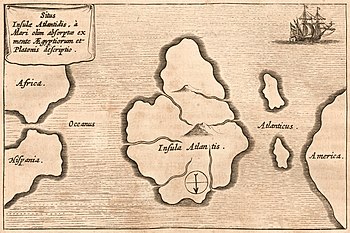
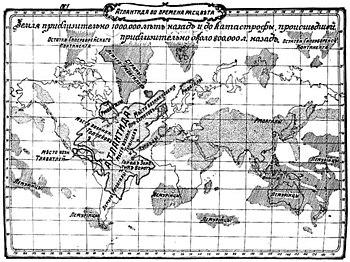
Atlantis
(Ancient Greek: Atlantis nesos, "island of Atlas"
is a fictional island mentioned in an allegory on
the hubris of nations in Plato's works Timaeus and
Critias, wherein it represents the antagonist naval
power that besieges "Ancient Athens", the
pseudo-historic embodiment of Plato's ideal state
in The Republic. In the story, Athens repels the Atlantean
attack unlike any other nation of the known world,
supposedly bearing witness to the superiority of Plato's
concept of a state. The story concludes with Atlantis
falling out of favor with the deities and submerging
into the Atlantic Ocean.
Despite
its minor importance in Plato's work, the Atlantis
story has had a considerable impact on literature.
The allegorical aspect of Atlantis was taken up in
utopian works of several Renaissance writers, such
as Francis Bacon's New Atlantis and Thomas More's
Utopia. On the other hand, nineteenth-century amateur
scholars misinterpreted Plato's narrative as historical
tradition, most famously Ignatius L. Donnelly in his
Atlantis: The Antediluvian World. Plato's vague indications
of the time of the events (more than 9,000 years before
his time) and the alleged location of Atlantis ("beyond
the Pillars of Hercules") gave rise to much pseudoscientific
speculation.As a consequence, Atlantis has become
a byword for any and all supposed advanced prehistoric
lost civilizations and continues to inspire contemporary
fiction, from comic books to films.
While
present-day philologists and classicists agree on
the story's fictional character, there is still debate
on what served as its inspiration. Plato is known
to have freely borrowed some of his allegories and
metaphors from older traditions, as he did, for instance,
with the story of Gyges. This led a number of scholars
to investigate possible inspiration of Atlantis from
Egyptian records of the Thera eruption, the Sea Peoples
invasion, or the Trojan War. Others have rejected
this chain of tradition as implausible and insist
that Plato created an entirely fictional account,
drawing loose inspiration from contemporary events
such as the failed Athenian invasion of Sicily in
415–413 BC or the destruction of Helike in 373
BC.
(Credit:
Wikipedia)
Profiles
Islands
World
Directory
|