|
The Matrix

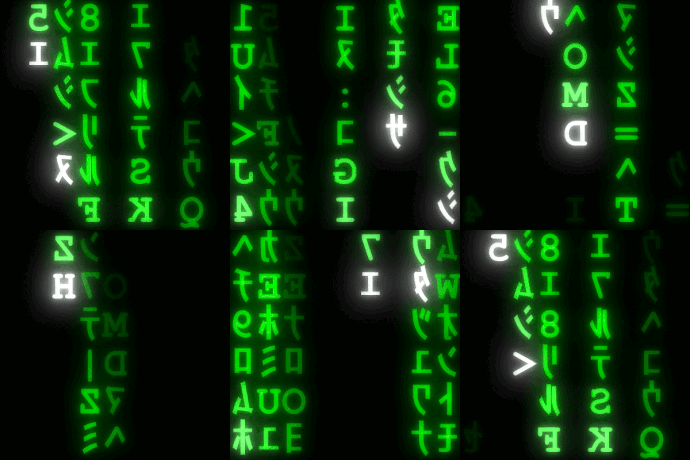

Neo
The
Matrix
Profile
The
Matrix is a 1999 science fiction-action film written
and directed by Larry and Andy Wachowski and starring
Keanu Reeves, Laurence Fishburne, Carrie-Anne
Moss, Joe Pantoliano, and Hugo Weaving. It was
first released in the USA on March 31, 1999, and
is the first entry in The Matrix series of films,
comics, video games, and animation.
The film describes a future in which reality perceived
by humans is actually the Matrix: a simulated
reality created by sentient machines in order
to pacify and subdue the human population while
their bodies' heat and electrical activity are
used as an energy source. Upon learning this,
computer programmer "Neo" is drawn into
a rebellion against the machines. The film contains
many references to the cyberpunk and hacker subcultures;
philosophical and religious ideas; and homages
to Alice's Adventures in Wonderland, Hong Kong
action cinema, Spaghetti Westerns, dystopian fiction
and Japanese animation. (Credit:
Wikipedia)
Cast
Keanu
Reeves as Thomas A. Anderson/Neo: A computer programmer
who moonlights as the hacker Neo, later to realize
he is the One when trying to rescue Morpheus from
the Agents.
Laurence Fishburne as Morpheus: A human freed
from the Matrix, captain of the Nebuchadnezzar.
He is the one who finds Neo and taught him the
truth.
Carrie-Anne Moss as Trinity: Freed by Morpheus,
crewman of the Nebuchadnezzar and Neo's romantic
interest.
Hugo Weaving as Agent Smith: A sentient "Agent"
program of the Matrix whose purpose is to destroy
Zion and stop humans from getting out of the Matrix;
but who, unlike his compatriots, has ambitions
to free himself from his duties.
Joe Pantoliano as Cypher: Another human freed
by Morpheus, who betrays Morpheus to the Agents
to ensure his return to the Matrix.
Julian Arahanga as Apoc: A freed human and crew
member on the Nebuchadnezzar. Killed by Cypher.
Anthony Ray Parker as Dozer: A "natural"
human born outside of the Matrix, and pilot of
the Nebuchadnezzar.
Marcus Chong as Tank: the "operator"
of the Nebuchadnezzar, he is Dozer's brother,
and like him was born outside of the Matrix.
Matt Doran as Mouse: A freed human and programmer
on the Nebuchadnezzar.
Gloria Foster as the Oracle: Exiled sentient computer
program who still resides in the Matrix, helping
the freed humans with her foresight and wisdom.
Belinda McClory as Switch: A human freed by Morpheus
and crew member of the Nebuchadnezzar. Killed
by Cypher.
Paul Goddard as Agent Brown: One of two sentient
"Agent" programs in the Matrix who work
with Agent Smith to destroy Zion and stop humans
escaping the system.
Robert Taylor as Agent Jones: Second sentient
"Agent" program working with Agent Smith.
Production
The
Matrix was a co-production of Warner Bros. Studios
and Australian Village Roadshow Pictures, and
all but a few scenes were filmed at Fox Studios
in Sydney, Australia, and in the city itself.
Recognizable landmarks were not included in order
to maintain the setting of a generic American
city. Nevertheless, the Sydney Harbour Bridge,
Anzac bridge, AWA Tower, Martin Place and a Commonwealth
Bank branch are visible in some shots, as is signage
on buildings for the Sydney offices of Telstra
and IBM Corporation among others. Other clues
remain, such as the sign next to the elevator
in the famed lobby scene reading "do not
use lift during fire." (as opposed to elevator);
and the "Authorised Personnel Only"
sign (American spelling would be Authorized Personnel
Only) on the door of the rooftop of the building
where Morpheus was kept. In addition, in some
scenes, traffic flow on the left hand side can
be observed, which is another give-away for the
filming location.
Subtle nods were included to Chicago, Illinois,
the home city of the directors, through a subtly
placed picture of the Chicago skyline, city maps,
and place names like the Adams Street Bridge,
Wells and Lake, Franklin and Erie, State and Balbo,
and Wabash and Lake.
The rooftop set that Trinity uses to escape from
Agent Jones early in the film was leftover from
the production of Dark City, which has been remarked
upon due to the thematic similarities of the films.
According to The Art of the Matrix, at least one
filmed scene and a variety of short pieces of
action were omitted from the final cut, and have
(to date) not been published.
The Wachowski Brothers were keen that all involved
understood the thematic background of the movie.
For example, the book used to conceal disks early
in the movie, Simulacra and Simulation, a 1981
work by the French philosopher Jean Baudrillard,
was required reading for most of the principal
cast and crew.
Websites
The
Matrix
What
Is The Matrix
The
Matrix Wikia
News
The
legacy of 'Fight Club' and 'The Matrix'
October
6, 2024
Broadcast
via All Things Considered
SCOTT
DETROW, HOST:
The
society cannot be trusted. The system is your enemy.
Man is asleep. These are some of the ideas that bring
together two of the most influential and debated American
films of the past 25 years.
(SOUNDBITE
OF FILM, "THE MATRIX")
LAURENCE
FISHBURNE: (As Morpheus) The matrix is everywhere.
It is all around us.
(SOUNDBITE
OF FILM, "FIGHT CLUB")
BRAD
PITT: (As Tyler Durden) The first rule of fight club
is you do not talk about fight club.
DETROW:
We've been talking about the movies of 1999 here for
months. And for many people, two 1999 movies loom
above the rest, both as movies in their own right,
but also as pop culture that has shaped our vocabulary
and our thinking decades after they first came out
- "The Matrix, " directed by Lilly and Lana
Wachowski, and "Fight Club, " directed by
David Fincher. We wanted to pair these two together
for our final conversation about that year in film
because both have broad appeal that crosses a whole
range of spectrums, gender and politics specifically.
Depending
on who you talk to, "The Matrix" is an anti-capitalist
screed, a rallying cry for the alt-right or a trans
allegory. "Fight Club" is either a celebration
of a certain kind of manhood or a critique of it.
We want to unpack how these two films have been interpreted
over the years. So we called two writers who have
thought a lot about it - writer and culture critic,
Emily St. James, and Peter C. Baker, a novelist who
writes for the music site Tracks on Tracks. Welcome
to you both.
EMILY
ST JAMES: It's so good to be here.
PETER
C BAKER: Hi. Thanks for having me.
DETROW:
Let's focus on "Fight Club" a little first.
Emily, remind us of what their reactions were like
when it first hit theaters.
ST
JAMES: When it first hit theaters, it was a flop.
You know, it had its critical champions. It had people
who were saying this film is just way too hyper violent,
which if you watch it today, feels strange. We've
moved well beyond it in terms of hyper violence. But
at the time, it was greeted that way in some corners.
And then it kind of left theaters. And then it had
this thing where it got picked up on home video. It
was one of the first really big DVDs. People watched
it over and over and over again. It became kind of
its own subculture. But back in theaters, it was really
kind of roundly rejected, which I think people often
forget.
DETROW:
Peter, you have done a lot of writing where you talk
about exploring the so-called manosphere, you know,
these loosely sourced sites and blogs and forums and
message boards concerned with masculinity and men's
issues. And you wrote a story about this for The New
Yorker that was titled, "The Men who Still Love
Fight Club." Let's start with that. Who are those
men?
BAKER:
Well, in the story, I was interested in both tracing
this history, where in and through the early 2000s
"Fight Club" was picked up by these, frankly,
sort of nasty, you know, communities of so-called
pick-up artists. And other just sort of online communities
animated primarily by misogyny, who were not super
interested in the elements of the film that constituted
a critique of, like, a misogynistic masculinity. And
they were more interested in the sort of potential
excitement of a misogynistic masculinity.
DETROW:
Right.
ST
JAMES: I think it's interesting the degree to which
both of these films have been interpreted by many
of their viewers as within sort of an antifeminist
context. When "Fight Club" is very pointed
in how it doesn't really have moments where the characters
are like, yeah, it's all my mom's fault, or yeah,
it's all my ex-girlfriend's fault. They certainly
have moments of, like, romantic tension with the Helena
Bonham Carter character, Marla, but it is a film that
is much more about here's what's oppressing me. It's
my dad and it's capitalism. And, like, it's very direct
about that in a way that I forgot when I recently
rewatched it. There is, like, a weird streak of this
film that is careful to not touch that raw nerve,
and yet it was still interpreted by many people as
like, yeah, you know who's holding you down? It's
women.
DETROW:
Rewatching it and rereading the book, as well, I was
really surprised at how on point it was about the
alienation that a lot of people feel for modern culture
and what they do with it. Because I feel like how
people respond to be feeling left behind or left out
has been, like, a defining trait of global politics
in a way that's seen a lot of really negative implications
over the last decades or so. And 25 years ago, this
movie is really narrowing in on these guys who feel
like there's nothing for them in society.
ST
JAMES: Yeah. I have often called this movie, "The
Matrix," "American Beauty," some others
like the Cameron Crow 2001 film, "Vanilla Sky"
- I call them end of history movies after the Francis
Fukuyama essay that became very well-known and very
influential and also quite wrong in the end. But,
like, the idea is sort of in the late '90s, early
2000s, there's this sense that we've reached the pinnacle
of human civilization, and it is liberal democracy
coupled with capitalism, and we're all happy about
that. And these movies are like, but I still feel
spiritually empty. I still feel like something's wrong.
I'm still not getting the meaning I need out of life.
And
it does feel like "Fight Club" is especially
tying that to how men feel about that aspect of their
lives. The way that, like, just buying stuff doesn't
fill them up. But also, like, just committing violence
doesn't fill them up. There's, like, a need for connection
that this movie is exploring, but it's like they won't
admit to themselves that they have this need for connection,
so they have to center it on violence, on blowing
things up. It's a very devastating critique of a certain
kind of masculinity through those lens. But it is
very much rooted in that time period in a way that
still speaks to us today.
DETROW:
Let's shift to focus on "The Matrix" a little
bit now. When it comes to cultural impact today, I
feel like we need to start with the idea of the red
pill. Let's listen to the scene where Morpheus is
offering Neo two options.
(SOUNDBITE
OF FILM, "THE MATRIX")
FISHBURNE:
(As Morpheus) You take the blue pill. The story ends.
You wake up in your bed and believe whatever you want
to believe. You take the red pill. You stay in Wonderland,
and I show you how deep the rabbit hole goes.
DETROW:
Peter, let's go back to the group of people you zoomed
in on in that article and spent a lot of time talking
to. How has that world appropriated the idea of the
red pill in conversation, in thinking?
BAKER:
Well, it's almost so simple and direct an appropriation
that it very quickly becomes something that has nothing
to do with the movie. But originally, you know, this
idea or this online community called the Red Pill
sprang up. And in the movie where it's suggested that
by taking the red pill, the main character can sort
of wake up and begin to realize the deep truth about
the world, which in the case of "The Matrix"
is that all of us are living in a computer simulation.
Online, this sort of, quote/unquote "men's rights"
community, the red pill, the revelation to be woken
up to was that feminism, you know, certain modern
views about relationships between the genders, were
a big lie. That it was in a man's best interest to
wake up from, to be awoken from, to find his fellow
newly enlightened men and figure things out alongside
them on message boards online.
DETROW:
Yeah. I do want to talk specifically about one reading
that has really become increasingly prominent in recent
years, and that's a lot of people talking about it
and reading about it and, you know, support from the
directors about the idea that it's a trans allegory.
Can you tell us about how that conversation has developed
and also what some of the key plot points on screen
really support that read?
ST
JAMES: Sure. I mean, we'll just start with the red
pill. When the Wachowskis were making this movie,
the pill that you took - the estrogen pill that you
took was red. And that often has been seen as like,
oh, of course, the pill that you have to take to see
the reality is estrogen. I don't like that limited
of a read of the film. I think that the film contains
many different metaphors within it. But certainly,
it is a movie about when something in your life just
feels wrong. And you wake up to the fact that what
is around you is a constructed system, which I think
for a lot of trans people is how they feel about gender.
But
one thing I think is fascinating is both of these
films involve queer folks behind the scenes in some
regard. Chuck Palahniuk, the author of the novel that
"Fight Club" is based on, is a gay man.
The Wachowskis are both trans women. It is interesting
that these movies, that are from queer perspectives,
ended up being so appropriated by people who are often
very anti-queer themselves.
DETROW:
I kind of want to end the conversation really zoning
in on each movie, and asking each of you what you
think in each one of these films, "Fight Club"
and "The Matrix," what holds up the best
or what you think about the most 25 years later when
it comes to just the way the film was made or the
story or the images or whatever it is. Emily, I'll
start with you.
ST
JAMES: I think, like, the core metaphors of them are
so endlessly able to be sort of stretched and manipulated
and turned into whatever you want them to be. I mean,
I think all the time about how "The Matrix"
or how "Fight Club" look at our relationship
to the society we live in in a way that constantly
reveals new aspects to me the older I get.
DETROW:
What about you, Peter?
BAKER:
I think they speak to this eternally recurring feeling
of alienation from your setting, from your context,
which can be anything. And they speak to the power
of that feeling of alienation once you decide to sort
of escape it or rebel against it. That's what's powerful
about them - the way that they latch on to that feeling
of disconnect of alienation and show all the places
that it can take you.
DETROW:
That's Peter C. Baker, as well as Emily St. James.
Thanks to both of you for taking the ALL THINGS CONSIDERED
pill and joining us to talk about "The Matrix"
and "Fight Club."
ST
JAMES: You're welcome.
BAKER:
Yeah, thanks.
(SOUNDBITE
OF ROB DOUGAN'S "CLUBBED TO DEATH)
Media
Man Int
*Technical
assistance via XAI, Grok
Media
Man Austalia does not represent The Matrix
|