|
Tiger Mask, wrestling legend
Websites
Tiger
Mask movie website WWE
- Tiger Mask
Tiger
Mask (Wikipedia)
Video
Tiger
Mask vs. Dynamite Kid:July 29, 1983 (WWE YouTube)
Tiger
Mask vs. Jose Estrada - 11/21/1982 (WWE YouTube)
2006.06.17
BEST OF THE SUPER Jr. SEMI FINAL TIGER MASK vs JYUSHIN
THUNDER LIGER (NJPW YouTube)
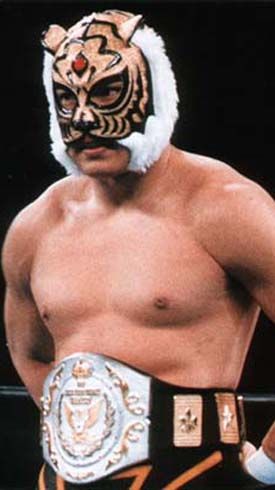
It
would be difficult to overstate the influence of the
original Tiger Mask. In the early 1980s, when the
masked highflier from Japan made his name as the world’s
finest junior heavyweight, watching one of his matches
was like looking into the future of professional wrestling.
At a time when most Superstars were glued firmly to
the mat, Tiger Mask took to the sky, busting out Space
Flying Tiger Drops and twisting moonsaults that left
opponents — and announcers — completely
baffled.
If
Tiger Mask’s offense was ahead of its time, his
mythos was rooted firmly in the past. When he first
debuted in New Japan Pro Wrestling on April 23, 1981,
his royal blue tights and distinctive mask were immediately
recognized as the trademarks of a hero from a lively
1960s cartoon. The anime — which told the story
of a heroic professional wrestler who supports a children’s
hospital while battling a villainous cadre known as
the Tiger Cave — had been licensed by New Japan
executives who were trying to grow interest in their
budding junior heavyweight division.
The
character’s journey from two-dimensional animation
cels to the real world may have been an awkward one
were it not for Satoru Sayama. A former student of
WWE Hall of Famer Antonio Inoki and Karl Gotch, the
23-year-old had experienced modest success in Mexico
and England under the name Sammy Lee. But the moment
Sayama donned the striped hood — whiskers and
all — to defeat The Dynamite Kid in his debut
match, he turned Tiger Mask into something much more
than a cartoon come to life.
Over
the next two years, Tiger Mask would distinguish himself
as not only the top junior heavyweight in New Japan,
but in the entire world. On Jan. 1, 1982, he officially
staked that claim by winning the WWE Junior Heavyweight
Championship — which had made an unexpected journey
from New York to Japan around the waist of Tatsumi
Fujinami — with another triumph over The Dynamite
Kid. The rough Brit became Tiger Mask’s top rival
and the two men pushed each other to the limit in
matches that are just as exhilarating today as they
were in the days of VHS.
WWE
brought Tiger Mask to America in winter 1982, where
he battled future stars like Eddie Gilbert and Curt
Hennig from the majestic Madison Square Garden to
obscure corners of the northeast like Belleville,
N.J. Back in Japan, he continued to thrill against
rivals like The Dynamite Kid and Black Tiger —
another character from the “Tiger Mask”
series — while innovating maneuvers like Rey
Mysterio’s 619 (known in some circles as the
Tiger Feint Kick) and the Tiger Suplex.
Sayama
disowned the Tiger Mask persona in 1984, but the character
endures to this day. After first being adopted by
the legendary Mitsuharu Misawa, the cartoon hero has
remained a constant presence in the rings of Japan,
with a fifth competitor wearing the hood today. Still,
no version of Tiger Mask — and very few junior
heavyweights — had the cultural and professional
impact of Satoru Sayama. (WWE)
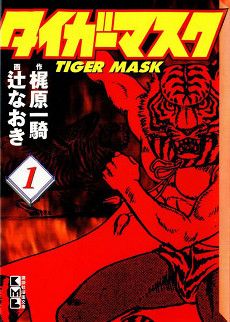
Tiger
Mask is a legendary professional wrestling persona
originating from the 1968 manga series by Ikki Kajiwara
and Naoki Tsuji, later adapted into a popular anime.
The character, a heroic masked wrestler, was brought
to life in 1981 by New Japan Pro-Wrestling (NJPW)
to boost its junior heavyweight division. Several
wrestlers have portrayed Tiger Mask, each contributing
to its legacy in Japanese wrestling. Below is a summary
of the key incarnations and their impact, based on
available information.Key Incarnations of Tiger MaskTiger
Mask I: Satoru Sayama (1981–1983) Debut: April
23, 1981, defeating Dynamite Kid for the WWF Junior
Heavyweight Championship.
Impact: Satoru Sayama, trained by Antonio Inoki and
Karl Gotch, revolutionized junior heavyweight wrestling
with a high-flying, martial arts-inspired style blending
lucha libre and technical wrestling. His matches against
Dynamite Kid, Black Tiger (Mark Rocco), and others
set a new standard for the division.
Achievements: First to hold both WWF and NWA World
Junior Heavyweight Championships simultaneously. He
won the WWF Junior Heavyweight title twice and the
NWA World Junior Heavyweight title twice.
Legacy: Sayama retired in 1983 due to frustration
with wrestling politics, but his influence endures.
He’s lauded as a pioneer, inducted into the Wrestling
Observer Newsletter Hall of Fame (1996) and the International
Professional Wrestling Hall of Fame (2021). Notable
Matches: His 1982–1983 series with Dynamite Kid,
including a five-star match at NJPW Big Fight Series
II (1983), is iconic. Other Ventures: Founded Shooto,
a pioneering MMA organization, and Real Japan Pro-Wrestling.
He also authored Kay Fabe (1985), exposing wrestling’s
inner workings.Tiger Mask II: Mitsuharu Misawa (1984–1990)
Background: After Sayama’s departure, All Japan
Pro Wrestling (AJPW) acquired the Tiger Mask rights,
and Mitsuharu Misawa, a future legend, took the role.
Career: Misawa continued the high-flying style but
transitioned to heavyweight wrestling, feuding with
Jumbo Tsuruta and Genichiro Tenryu. He unmasked in
1990 to wrestle as himself, becoming a cornerstone
of AJPW and later founding Pro Wrestling NOAH.
Achievements: Won the NWA International Junior Heavyweight
Championship, All Asia Tag Team Championships, and
PWF Tag Team Championships as Tiger Mask II. Note:
A 1990 match against Bret Hart (then Tiger Mask II)
was criticized for clashing styles, reflecting Misawa’s
discomfort with AJPW’s stiff style.Tiger Mask
III: Koji Kanemoto (1992–1994) Background: NJPW
regained the character, assigning it to Koji Kanemoto,
a young junior heavyweight.
Career: Kanemoto struggled to match the legacy of
his predecessors, overshadowed by Jushin Thunder Liger.
He lost the mask in a mask-vs-mask match against Liger
in 1994.
Impact: Least impactful of the main Tiger Masks, but
Kanemoto later thrived unmasked, winning 18 titles
in NJPW.Tiger Mask IV: Yoshihiro Yamazaki (1995–Present)
Debut: July 15, 1995, trained by Satoru Sayama and
The Great Sasuke, facing Sasuke at Korakuen Hall.
Career: The longest-reigning Tiger Mask, Yamazaki
started in Michinoku Pro Wrestling before joining
NJPW in 2002. Known for consistency and loyalty to
the character, he’s a prominent figure in the
junior heavyweight division.
Achievements: Six-time IWGP Junior Heavyweight Champion,
two-time IWGP Junior Heavyweight Tag Team Champion
(with Jushin Thunder Liger and Robbie Eagles), two-time
GHC Junior Heavyweight Tag Team Champion (with Liger
and Kanemoto), and AJPW World Junior Heavyweight Champion.
First to win NJPW’s Best of the Super Juniors
tournament back-to-back (2004–2005). Retirement:
Announced retirement for July 2026 after a loss to
Hiroshi Tanahashi at NJPW’s New Japan Soul event
on July 6, 2025, marking 31 years since his debut.
Legacy: Yamazaki’s longevity and title record
cement his status as a respected figure, carrying
forward the Tiger Mask legacy with a blend of traditional
and modern styles.Other Incarnations: Tiger Mask V:
Ikuhisa Minowa (2010): An MMA fighter who briefly
portrayed the character in a tag match for Maki Dojo
alongside Sayama. Tiger Mask VI: Toshio Fujiwara (2013):
A former kickboxer, believed to have appeared as a
second at a memorial event, wearing a modified costume
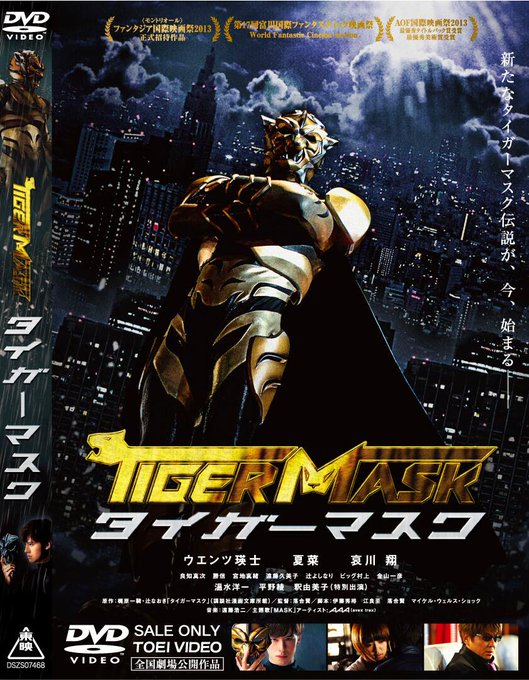
from the 2013 Tiger Mask film. Tiger Mask W: Kota
Ibushi (2016–2017): A temporary incarnation tied
to the Tiger Mask W anime, debuting in NJPW in 2016.
Ibushi teamed with Tiger Mask IV and later returned
to wrestling under his own name. Tiger Mask VII: Takeru
Segawa (2023): A kickboxer who assumed the role for
social contribution activities, not in-ring wrestling,
as part of the “7th Tiger Mask Project”
to support foster care independence.Signature Moves
and StyleMoves: Tiger Suplex (double underhook suplex),
Tiger Driver (double underhook powerbomb), Space Flying
Tiger Drop (cartwheel suicide corkscrew crossbody),
Crossface Chickenwing, Millennium Suplex, and Destroy
Suplex. Style: Combines high-flying lucha libre, technical
wrestling, and martial arts (judo, sambo, kickboxing),
pioneered by Sayama and adapted by successors.Related
CharactersBlack Tiger: An “evil twin” character,
first portrayed by Mark Rocco in 1981 to oppose Sayama.
Later incarnations included Eddie Guerrero and Tatsuhito
Takaiwa. Other Variants: Include Masked Tiger, Tiger
Dragon (Último Dragón), Super Tiger
II, Tiger Dream (Candy Okutsu), Tiger Queen (Asuka),
and Calgary Tiger (Ricky Fuji).Cultural ImpactTiger
Mask transformed junior heavyweight wrestling, making
it a dynamic, high-flying spectacle. Sayama’s
innovative style influenced global wrestling, from
cruiserweights to modern high-flyers. The character’s
manga and anime roots also made it a pop culture phenomenon,
with the mask symbolizing heroism and resilience.Current
StatusYoshihiro Yamazaki, as Tiger Mask IV, remains
active in NJPW but will retire in July 2026. His final
year is expected to showcase the character’s
enduring legacy. No successor has been announced,
leaving the future of Tiger Mask uncertain.
|