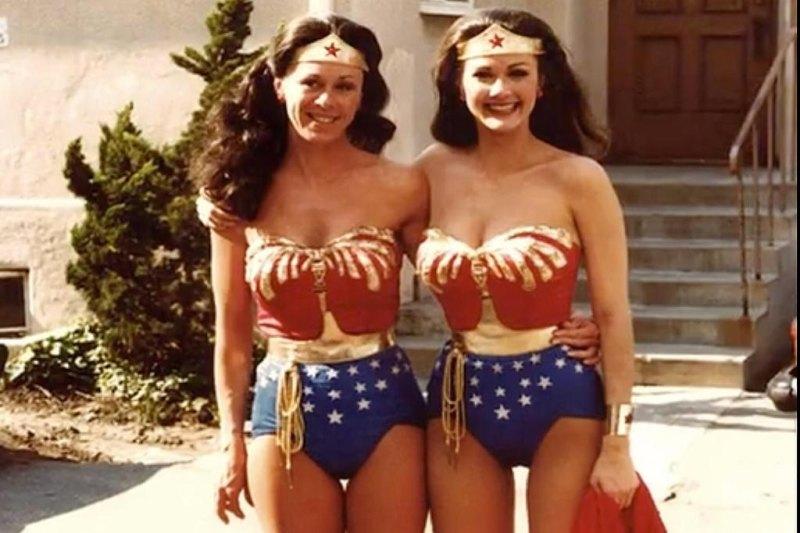
Jeannie
Epper, left, as Lynda Carter’s stunt double on
the 1970s series Wonder Woman.
By Kylie Northover
Stuntwomen:
The Untold Hollywood Story ****
SBS On Demand
Based
on a book of the same name by documentary-maker and
author Mollie Gregory — the first such history
— this documentary traces the work of stuntwomen
from the silent movie era until today. The trajectory
is likely not one you would expect.
In
the early years of the film industry, Hollywood employed
roughly the same number of men and women, and women
were highly involved in all aspects of film production,
including stunt work. Until the 1920s, women —
many from acting or dancing backgrounds — undertook
stunts including horse riding, car stunts, hanging
from buildings and diving into freezing water (all
before OH&S was of much concern, of course).
But
as movies became increasingly popular and more profitable,
women became marginalised in the industry, and by
the 1930s, stuntwomen were replaced by men wearing
women’s clothing and wigs (a practice still occasionally
used today, known as “wigging”). Until the
1960s, there was little stunt work available for women,
and even less to women of colour.
Narrated
by and featuring Michelle Rodriguez, who is accustomed
to working with stunt doubles in The Fast and the
Furious films, Stuntwomen features interviews with
some of the industry’s leading stuntwomen, as
well as filmmakers Paul Verhoeven, Paul Feig, Anne
Fletcher and Al Ruddy.
But
rather than intersperse these talking heads with vintage
footage (although there are plenty of stunt clips
here as well), director April Wright has paired younger
stuntwomen working today with older women who worked
in the industry from the 1970s onwards. It’s
an interesting device that works well to underscore
how the industry has changed — and in many ways
how it has not.
Jeannie
Epper, now 79, has worked as a stuntwoman in more
than 100 films and TV series, although she’s
best known as Lynda Carter’s body double on the
1970s hit Wonder Woman. She shares anecdotes of her
time on set, and she and other legends of the industry
— among them Peaches Jones, the first successful
black stuntwoman, who frequently doubled for Pam Grier,
and Debbie Evans, considered one of the top stunt
drivers — exchange stories with their younger
counterparts working in the industry today.
The
film also offers insights into the nuts and bolts
of the physicality involved and danger involved in
the stunts — all fascinating stuff, but the real
revelations here are not the stories of stunts gone
wrong or horrific injuries that these women all reel
off (broken shoulders, missing teeth, twisted ankles;
the list goes on).
The
most shocking stories are about the industry’s
sexism and racism, which seem almost as prevalent
today as 40 years ago: women being second-guessed
on their approaches to different stunts, how much
harder it is to do a stunt in high heels and skimpy
clothing (which offers little room for padding), how
often these women are asked to “lose a few pounds”
just weeks away from a shoot, and how few stunt co-ordinators
— the obvious career progression when one gets
too old to leap off buildings — are women.
Despite
the obstacles and the lack of recognition outside
the industry (who looks out for the stunt crews’
names in movie credits?) the women Wright has interviewed
here are all passionate about their work — many
stuntwomen’s kids also enter the business —
and their stories surprisingly relatable, even to
those of us who don’t throw ourselves over cliffs
or self-immolate for a living.
Stuntwomen:
The Untold Hollywood Story is on SBS On Demand.